Queer Gameplay by Design: Silksong and Queer Game Studies
Posted:
12/15/2025
Categories:
games
,
wgss
Once I took a few hours to walk around Night City in Cyberpunk 2077, looking at all the flat and sloppily finished buildings. In my exploration of an apartment building off the beaten path, I stumbled through a hole in the digital asphalt, gazing up at the transparent backs of the ray-traced buildings, people, and cars as I hurtled through the emptiness of the simulated world. At the time, I would define queer gameplay through my pink-haired butch avatar's flirting with the other female characters in the gritty futuristic story, but looking back at that walk through the poorly rendered streets of Night City through a queer studies lens I see that transgression of both the game's intent and its very substance in a different light.
What’s interesting when you ask this question of games, for example if you’re playing single-player games, is that people do strange things a lot of the time. They don’t necessarily play for the goal, or they goof around in various ways. Then the question is: What would queer playing entail? Would it mean having a game that allows you to do non-goal-oriented things? But are you supposed to follow the game’s logic or reject it? It’s a hard question, because games have so many variations on the theme of failure. (Jesper Juul in Queer Game Studies, edited by Bo Ruberg and Adrienne Shaw, 204)
As an entertainment medium, games are often not seen as a form of art or culture worthy of critique. However, from the early 2000s to the present game studies has emerged as a branch of media studies ripe for analysis and critique. More recently, the field of queer game studies has emerged to examine games, communities, and players through a queer studies lens. Queer game studies (and my writing here) rely on the "subjectless critique" of queer studies; that is, the shift in the field of queer studies from examining issues of gay and lesbian individuals to systems which delineate groups and behaviors as normative or non-normative (Somerville). This analysis is heavily based on Bo Ruberg's book Video Games Have Always Been Queer, which seeks to find queerness in games beyond representation. There's a section of the book which focuses on queer game playing, connecting non-normative or unintended routes to experiencing games with queer theory and calling the reader to imagine behaviors of queer gameplay. Although Ruberg conceptualizes queer play as breaking the mold defined by the game's ruleset, as a game developer I'm curious about how games can encourage queer play. I believe one example of a game encouraging queer play is Hollow Knight: Silksong, which contains sections that teach the player to break the rules, find new ways to play, and embrace discomfort.
Silksong is a Metroidvania, a genre of sidescrolling action game set in a nonlinear open world where progression is checked through movement abilities. For example, instead of a new area being locked behind a door to which the player needs to find a key, it would be locked behind two platforms between which a player needs an air dash ability to move. The playable character, Hornet, as well as all non-playable characters (NPCs) and enemies are bugs (insects, arachnids, some crustaceans) of various stages of anthropomorphism, and the terrain the player traverses is a series of caves and tunnels in which these bugs live. Hollow Knight and Silksong are fantastical stories; magic of various forms flavors the world and empowers players and enemies alike, and god-like figures awaken sapience in normal bugs, shaping subterranean societies and ruling over them. The setting of Silksong is the kingdom of Pharloom, whose subjects are encouraged to undergo a pilgrimage to the Citadel, the religious center of the kingdom and the seat of power of the god-like being at its origin. Hornet must attempt her own pilgrimage to investigate the forces that brought her to Pharloom against her will and caused the silken infection which is driving bugs mad.
Two couriers in Silksong, Tipp and Pill, are behind on their deliveries and need Hornet to deliver supplies across the vast, expansive map of Pharloom. The catch? The supplies are too delicate to be jostled in transit on the Bellways, Pharloom's fast travel network. Any deliveries a player carries will be destroyed after a trip in the fast travel or a certain number of hits from enemies. Ruberg describes Elizabeth Freeman's concept of chrononormativity, the "carefully syncopated tempo" of the heteronormative life (as cited on 188) to argue that slow walks through games constitute a queer behavior, challenging the chrononormative game time by slowing down and appreciating the scenic details (or lack thereof, in the example described in the introduction) rather than rushing to the next fetch quest, plot hook, or boss fight (208). The courier quest slow-down does not in itself constitute queer play, just another element of a simple side quest. However, the slow walks that the courier missions encourage show the player a way to traverse the map nontraditionally, teaching a queer gameplay behavior that the player can pursue at other points in game. Before seeking out these connections, I found tremendous enjoyment tracing winding routes across Pharloom and watching the scenery blend from one environment to the other gradually, seeking out the minor environmental stories that reveal nuggets about the world and its inhabitants. After delivering supplies to one of the outposts dotted across the map, a player might find themself retracing the routes they took with the couriers' packages, unburdened by the tension of that task.
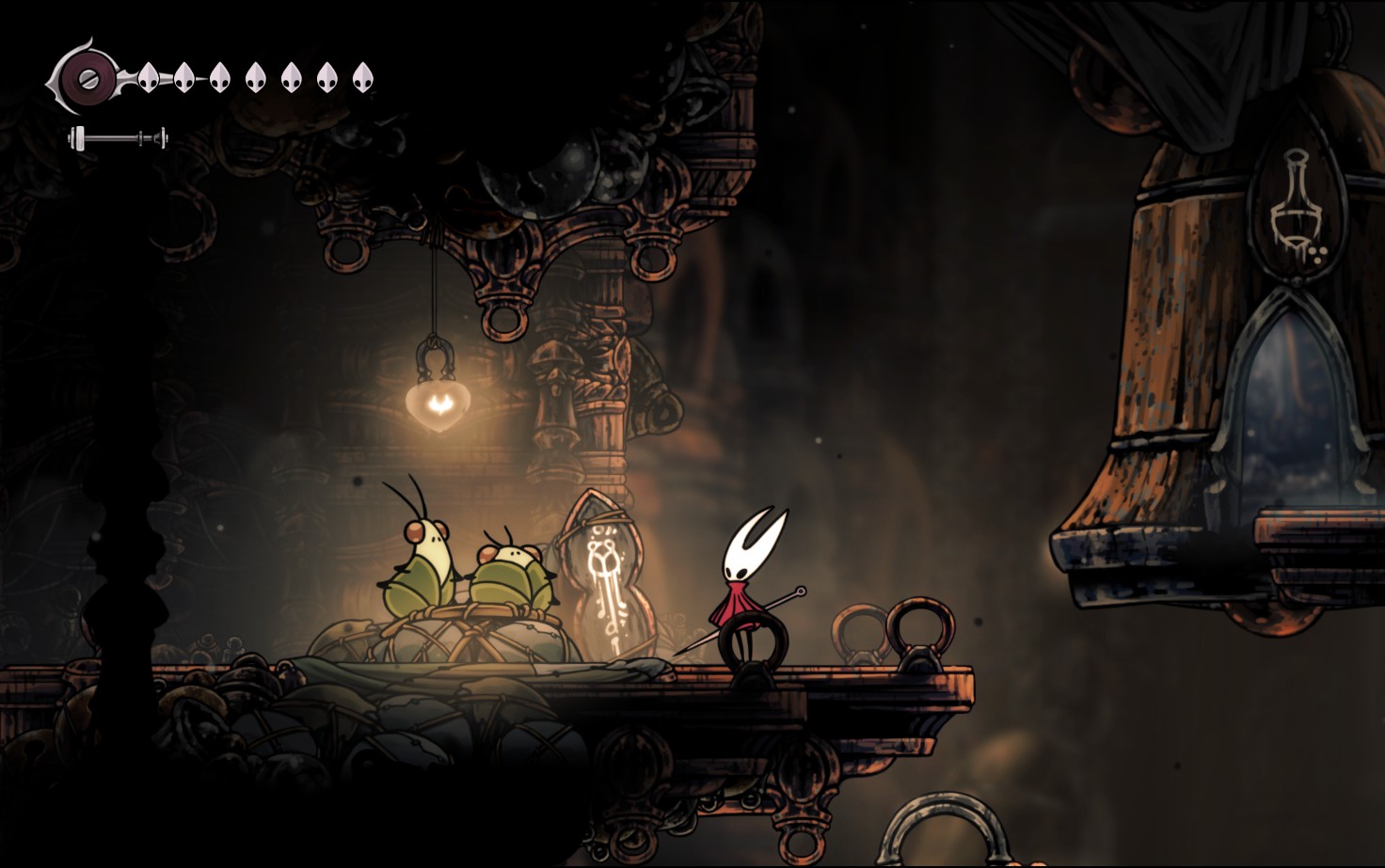
In a broader quest where Hornet must trade ingredients from far and wide for an item that will help her on her journey, Tipp and Pill offer her the Courier's Rasher, a portion of meat popular with bugs of their profession. This delivery functions similarly to the others, with one key exception: it's timed, with any hits taken running down the timer significantly. This teaches the player speedrunning, another behavior Ruberg describes as challenging a game's chrononormativity (195). I'm not simply arguing that Silksong teaches players to move fast (Sprintmaster Swift, who challenges Hornet to progressively more complicated races, may be the better example in that case) but to plan, practice, and perfectly execute an optimal route through a game. At the core of speedrunning (especially in nonlinear games like Silksong) is this route-finding optimization. New top runs are often discussed based on what route they take through the world, whether they fight this or that boss, and go through this or that corridor. There are many such routes one can take from Bellhart, Tipp and Pill's home base, to the rasher's destination in the Citadel, each with reasonable rationale for the player taking them. In this way the brothers Tipp and Pill paradoxically instruct the player both in speeding up and slowing down from the normal gameplay behavior of Silksong.

Silksong's Metroidvania genre elements allow for a certain transgression; players can get to "off-limits" areas before they're technically allowed to through certain exploits of the game's design. These are called "skips," when a player bypasses an ability check using unintended gameplay behavior. Although Ruberg doesn't directly define these behaviors in Video Games Have Always Been Queer, I argue these constitute queer gameplay because of their transgression of the game's natural order. But does Silksong encourage the player to find skips? As I mentioned previously, there are multiple paths to the Citadel, Hornet's goal in the first act of the game. This is a game which encourages finding alternate paths and rewards the inquisitive player. Approaching the Citadel through the "Exhaust Organ," its waste disposal network accessible only through a well-hidden breakable wall rather than the Grand Gate feels like getting away with something much like executing a skip feels like getting away with something, but the first is intended behavior and the second is transgressive. In this case, intended gameplay mirrors queer gameplay, once again creating a scenario where players are instructed in the queer gameplay practices we're interested in.
This idea that you want to play to win, and that only winning will do, is not simply wrong about games, it’s wrong about the human. That feels to me to be a very queer insight. (Jack Halberstam in Queer Game Studies)
In their book Ruberg puts in conversation Jack Halberstam, who wrote The Queer Art of Failure and Jesper Juul, the author of The Art of Failure: An Essay on the Pain of Playing Video Games. At the core of Halberstam's book is the argument that parallels queerness as a failure to conform to the standard pushed by heteronormativity to failure to conform to other standards of normative society. Ruberg applies this to games, defining failing at a game as a queer behavior. They apply this specifically to "failing against" a game, that is, failing at a game in some way that is counter to the intended behavior, and then more broadly positing "if we accept failure as fundamental to games and we accept failure as coded as queer, all games become queer, in a non-representational sense" (156). Silksong does not encourage the player to fail against the game, to throw oneself into spike pits or be consumed by ravenous predatory bugs. Silksong wants players to win, to climb to the very top of Pharloom and tear down its matriarch. But along the way, Silksong does encourage defeat, more so than most games, in players "failing towards" the game. The sequel to Hollow Knight, well known in its own right for some very punishing sections, has garnered much online attention in the past few months for being difficult. In my playthrough there were several fights I thought I might never get past, flinging Hornet at the enemy ten or twenty times before skill, memorization, and luck aligned to my favor. While Silksong does not teach the player to intentionally lose at the game, it does require the player to embrace failure, as much of the game will be spent losing repeatedly.
I've identified behaviors deemed queer by their nature as counter to intended gameplay, and sought to uncover the ways in which Hollow Knight: Silksong teaches and encourages players to embody those behaviors. This research brings to light a few important questions: If gameplay can be queer (or queered), are all games queer? Ruberg actually answers this question. Video Games Have Always Been Queer seeks to discover queerness in all games, regardless of textual representation, and one generalization of this is that all games have the potential to be queer because all games have the potential to be played queerly. If we accept Ruberg's assertion that all games are queer (or have the potential to be), why does Silksong's encouragement of queer gameplay stand out against other games? Many games have the potential to be played queerly, but to invite this behavior is rare. Silksong surely is not alone in this quality, but it stands out as an example of a game which, through failure built into its game design, inquisitiveness in wayfinding encouraged by its genre aspects, and transgressions of temporality encouraged by its story, teaches queer gameplay by its very nature.
References
Ruberg, Bo. Video Games Have Always Been Queer. NYU Press, 2019.
Ruberg, Bo, and Adrienne Shaw, editors. “The Arts of Failure: Jack Halberstam in Conversation with Jesper Juul.” Queer Game Studies, University of Minnesota Press, 2017, pp. 201–10.
Somerville, Siobhan B. “Queer.” Keywords for American Cultural Studies, Second Edition, edited by Bruce Burgett and Glenn Hendler, 2nd ed., NYU Press, 2014, pp. 203–07.
Hollow Knight: Silksong. Team Cherry, 2025. Apple MacOS game.
Cyberpunk 2077. CD Projekt Red, 2020. Microsoft Windows Game.